
How an Ayurveda College in Kerala Prepares Students for Real-World Clinical Practice
Choosing Ayurveda as a career is not just about learning treatments or herbal medicines. It is about embracing a timeless science of healing that focuses on balance, prevention, and holistic wellness. For students who want to become confident and capable practitioners, studying at an Ayurveda College in Kerala offers a unique advantage. Kerala is often called the home of authentic Ayurveda, where tradition, nature, and clinical practice come together to create an ideal learning environment.
Unlike purely classroom-based education, Ayurvedic training here is immersive. Students don’t just study science, they experience it daily through hospitals, therapies, herbal gardens, and patient interactions. This blend of knowledge and hands-on exposure prepares them for the realities of clinical practice from day one.
Let’s understand how this practical approach shapes skilled Ayurvedic professionals ready to serve real patients.
Building a strong foundation in Ayurvedic principles
Every successful practitioner begins with clarity in the basics. Students first develop a deep understanding of classical Ayurvedic philosophy, including doshas, dhatus, malas, agni, and prakriti. These principles form the backbone of diagnosis and treatment.
Rather than memorizing concepts, learners are encouraged to interpret and apply them. Teachers use real-life case examples to explain how imbalances appear in the body and how they can be corrected naturally. This method helps students think like practitioners rather than exam-focused learners.
By the time they step into clinical settings, they already have a solid theoretical base that guides every decision they make.
Early exposure to real patients
One of the biggest advantages of studying in Kerala is early clinical exposure. Many colleges integrate hospital visits from the initial years itself. Students observe consultations, assist senior doctors, and interact with patients.
This exposure builds confidence. Instead of feeling nervous in hospitals later, students gradually become comfortable with patient communication, history taking, and diagnosis. They learn how different individuals respond to treatments and how to adapt their approach accordingly.
Seeing theory come alive through real cases makes learning meaningful and memorable.
Hands-on Panchakarma training
Panchakarma is one of Ayurveda’s most powerful healing methods, but it requires precision and skill. Kerala is world-famous for authentic Panchakarma therapies, making it the perfect place for practical training.
Students receive direct experience in therapies such as:
- Abhyanga
- Shirodhara
- Swedana
- Vamana and Virechana
- Basti treatments
- Nasya
They don’t just watch demonstrations. They actively perform procedures under supervision. They understand preparation methods, patient suitability, safety precautions, and aftercare.
This hands-on practice ensures that graduates can confidently conduct therapies in real clinical environments.
Learning from experienced mentors
A key strength of Ayurvedic education in Kerala is guidance from seasoned Vaidyas and physicians. These experts bring decades of clinical experience and share practical wisdom beyond textbooks.
They discuss complex cases, share success stories, and even talk about challenges and mistakes. This honest learning process helps students understand that medicine is both science and intuition.
Mentorship plays a huge role in shaping clinical judgment. Students gradually develop the ability to analyze symptoms, choose the right treatments, and modify plans based on patient progress.
Training in herbal identification and medicine preparation
Ayurveda relies heavily on natural herbs and formulations. To truly understand medicines, students must know their source.
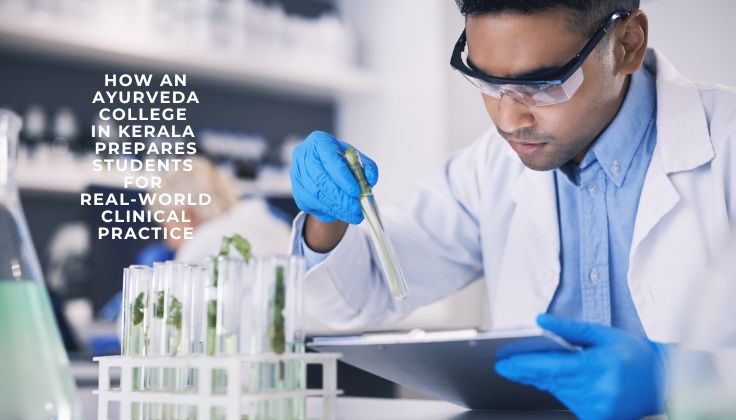
Most colleges maintain herbal gardens where students learn to identify plants directly. They see how herbs grow, how they are harvested, and how their potency varies with seasons. This real-world exposure creates a deeper connection with science.
Pharmacy training further teaches them how to prepare oils, powders, decoctions, and medicated ghees. Understanding formulation methods improves their confidence when prescribing medicines later.
Integration with modern healthcare knowledge
Today’s patients often come with lab reports and modern diagnoses. To handle such cases responsibly, Ayurveda students are also introduced to basic modern medical sciences.
Subjects like anatomy, physiology, pathology, and diagnostics help them understand conditions from both Ayurvedic and modern perspectives. They learn to interpret test results and collaborate with other healthcare professionals when needed.
This balanced training ensures safe, effective, and comprehensive patient care.
Case management and independent practice
As students move to advanced years, they start managing cases under supervision. This stage is where real transformation happens.
They take patient histories, examine symptoms, suggest treatments, and monitor outcomes. Every case teaches something new — sometimes success, sometimes improvement areas.
Gradually, students develop critical thinking and decision-making skills. By the end of the course, they are no longer just learners but capable practitioners ready to treat patients independently.
Community outreach and real-world exposure
Ayurveda is deeply connected to community wellness. Many colleges organize health camps and outreach programs in villages and urban areas.
Students participate in consultations, awareness programs, and preventive care initiatives. These experiences teach them how to work with people from different backgrounds and manage diverse health issues.
More importantly, they develop empathy and compassion — qualities that define a true healer.
Focus on ethics and patient communication
A good doctor is not defined only by knowledge but also by how they treat patients. Ayurvedic training emphasizes ethics, professionalism, and clear communication.
Students learn to listen carefully, explain treatments simply, and respect patient concerns. This human connection builds trust and improves treatment outcomes.
Such soft skills are just as important as clinical expertise in real-world practice.
Training in Kerala offers more than a degree. It provides an immersive, practical, and holistic learning journey that prepares students for real clinical challenges. From early patient exposure and Panchakarma practice to herbal knowledge and mentorship, every aspect of education focuses on building confident, compassionate practitioners.
For those who wish to expand their skills or continue learning beyond campus, options like an Online panchakarma course can further enhance practical understanding and keep knowledge updated in today’s evolving healthcare landscape. Together, these opportunities ensure that the next generation of Ayurvedic doctors is well-equipped to deliver authentic and effective healing wherever they practice.