
Are Marma Points Dangerous? What Training Courses Explain About Precautions
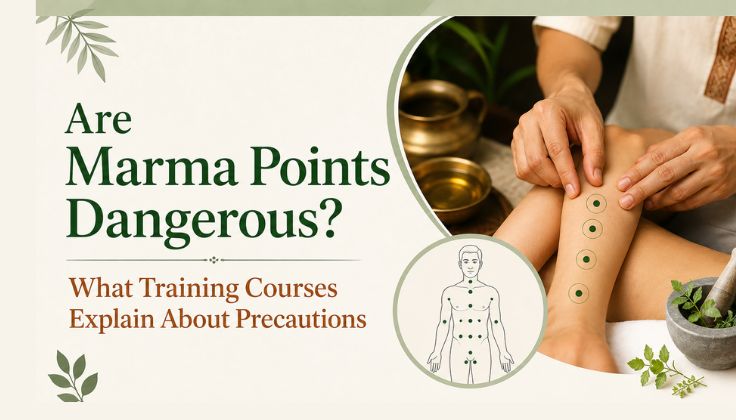
According to the principles of Ayurveda, marma points are known as vital anatomical regions where the physical body crosses with the energy of life called “Praana”. As per Ayurveda, there are a total of 107 such points spread across the human body, most of which are located at intersections where muscles, veins, ligaments and joints come together. Marma therapy is traditionally employed in holistic healing and ancient martial arts known as “Kalari Payattu”. It is used to get rid of energy blocks, minimize pain and boost the functioning of internal organs. But, in hindsight these body parts possess a very high concentration of blood vessels and nerves, and today questions regarding the safety of Marma therapy and the potential risks and dangers associated with it are frequently being raised.
In this blog, School of Ayurveda, an ayurvedic institution in Kerala will give an insight into the safety of Marma courses in Kerala, and precautions to be taken before undergoing the therapy.
Are Marma Points Inherently Dangerous?
Marma points are not innately dangerous per se when they are handled carefully with the right knowledge and skills, but does not imply that they must be approached without caution. A few classic and renowned Ayurvedic texts such as the Sushtrutha Samhita, classifies these regions based on their degree of vulnerability and adverse impacts of trauma. Certain points are in the human body that are classified as severe injuries called “Sadhya Pranahara” or “Kalantra Pranahara”, one that will become fatal over time, and other kinds of injuries are associated with permanent disability or deformation.
In the context of contemporary therapeutic healing, risks can primarily emerge due to incorrect application, applying more pressure than required, or the treatment being practiced by unqualified hands. Since these points are directly connected to all major nerves, arteries and other important organs, incorrect application will cause bruises, nerve irritation or damage can potentially drain energy and can also pave the way for exhaustion, lethargy, and pain in certain areas of the body.
What Professional Training Courses Teach About Safety
In most professional courses and programs in Ayurveda and Marma Therapy, parameters such as safety, anatomy and precision are viewed as fundamental building blocks of education and training. The curriculum introduces students to the boundaries of each point in order to prevent and stonewall unwanted complications and side effects. Training programs focus on precautionary methods and safety protocols that must be incorporated during every clinical session.
Western Anatomy Correlation
Ayurveda courses highlight Students are trained to bring together the holistic concepts of Ayurveda and conventional western biomedical science. Courses emphasize the unique underlying structures of each marma point. For example, manipulation close to the “Nila” or “Manya” marma points in the neck needs a thorough understanding of the carotid artery and the vagus nerve. Moreover, marma practitioners are never taught to apply strong, forceful pressure onto these regions in order to avoid limiting the flow of blood to the brain or foster irreversible drops in blood pressure.
The Doctrine of Gentle Pressure
There is a common misconception that employing excessive pressure leads to better results. Training programs actively combat this rule by teaching students the doctrine of subtle intervention. Since Marma therapy is designed to have an effect over the nervous system and the smooth flow of “Praana”, light touch, circular motions and certain essential oils are given more priority than deep tissue mobilization. As a matter of fact, heavy structure pressure is mostly limited to specific strong points in the limbs, but even then the therapies are carefully regulated to avoid negative impacts.
Contraindications and Vulnerable Populations
A substantial chunk of professional training in Marma Therapy focuses on when it should not be considered as a treatment option or be customized to align with the needs of the individual. The major contraindications imparted in accredited and certified programs include:
Pregnancy:
Due to uterine contractions, certain regions on the lower abdomen, sacrum and hands, (also known as Kshipra Marma) are avoided.
Acute Medical Conditions:
Marma therapy is not recommended for regions with tendencies of high blood clots, open wounds and injuries, malignant tumors or severe skin conditions with inflammation.
Severe Debilitation:
Abnormally thin and extremely fragile individuals are handled with minimal energetic touch, extreme care and non-invasive methods to protect their highly sensitive and vulnerable systems.
Safe Practices and the Role of Certification
When done by a certified professional practitioner, marma therapy is considered a safe and secure treatment modality. Before any points are touched, risk of complications are meticulously mitigated through a comprehensive pre-treatment assessment of the patient's medical history and specific sensitivities.
For individuals looking to experience Marma Therapy or undergo an online Panchakarma course, It is important to seek the services of a certified, seasoned practitioner. Relying on self therapy and online resources are not recommended or encouraged, especially when it is regarding the points located on the head, neck and torso.