
The Role of Digital Learning in Preserving Ancient Ayurvedic Knowledge
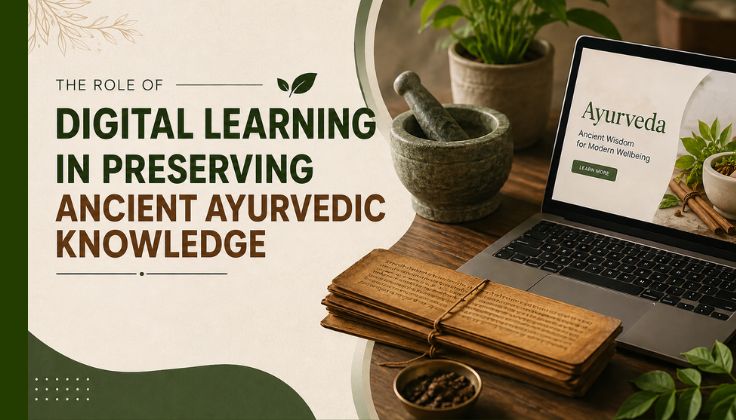
Ayurveda, the ancient Indian system of medicine that has been passed down for generations since time immemorial. Ever since its inception this profound system of health and wellness banked on the Guru-Shisya parampara, an oral tradition grounded in rigorous apprenticeship and training based on lineage, with carefully written Sanskrit manuscripts on palm leaves. However, the durability and fragility of physical items and the gradual decrease in the number of seasoned traditional scholars made it impossible to maintain the continuity of this wisdom. In today’s contemporary digital-first era, virtually mediated learning is becoming a vital medium for the conservation, perpetuation, and global proliferation of Ayurvedic knowledge.
In this blog, School of Ayurveda, an ayurvedic college in Kerala will explain why it is important to have an Ayurveda course online and how it will transform the approach to holistic health and overall wellbeing.
Digital Archiving and the Safeguarding of Manuscripts
The safeguarding of the foundational tenets of Ayurvedic knowledge is being revolutionized through various large-scale digital archiving initiatives. Thousands of ancient manuscripts and texts which are vulnerable to ecological depletion and decay are being methodically digitized into high-fidelity assets and high-resolution repositories.
Due to these digital preservation efforts, rare codices such as Charaka Samhita and Sushruta Samhita are safeguarded against physical disintegration. Moreover, highly advanced optical character recognition (OCR) is being used to transcribe age-old manuscripts into readable digital text. Doing this ensures that the original source materials of Ayurveda are preserved and immunized for posterity but are also made easily available and accessible for scholars all over the world with the risk of damage or decomposition.
The Democratization of Ayurvedic Education:
Earlier, traditional ayurvedic education was textually locked and geographically isolated due to institutional constraints. The advent of digital learning platforms have drastically transformed and effectively democratized access to this ancient healing system. The same knowledge which was once limited to certain regions and specialized learning centers is now being globally offered through massive online courses, programs, webinars and specific e-learning portals.
The entire curriculum is being restructured and redesigned to fit modular online learning formats, therefore allowing students, healthcare professionals and wellness adherents from a wide variety of backgrounds and social standing to learn the principles of Ayurveda at their own pace. As a matter of fact, digital expansion makes sure that the foundational axioms of Ayurvedic medicine such as Prakriti (individual constitution) and Ritucharya (seasonal regimes) are being understood and are being practiced by a global audience far beyond its indigenous cradle.
Standardization and Quality Control through E-Learning:
One of the major historical challenges witnessed by Ayurveda is the contrast in interpretation and practice across multiple regions. Digital learning paradigms are being utilized by statutory authorities and academic institutions to systemize ayurvedic education. By maintaining centralized online compendiums, homogeneous definitions, pharmacological details of plants that hold medicinal value and monolithic operational directives are enforced and established.
Multimedia learning tools such as high-definition instructional videos and three-dimension (3D) anatomical models are utilized to educate complex and high value concepts such as Marma therapy and the meticulous formulations and compounding of galenical preparations. This digital standardization makes sure that the authenticity and legacy of ancient knowledge is maintained while effectively shielding the risk of professional misinterpretation and clinical negligence.
Bridging Ancient Wisdom with Modern Science
The incorporation of Ayurvedic healing practices into modern medical systems is significantly boosted by digital learning platforms. Bioinformatics, online research databases, and digital journals serve as the digital nexuses and provide the analytical infrastructure where foundational Ayurvedic axioms are compared and cross-referenced with modern pharmacological and biomedical research
E-learning modules are constantly evolving in order to educate contemporary medical professionals in the basics of Ayurveda and institutionalizing an ecosystem of integrative medical frameworks. By making use of collective online research platforms, all the data pertaining to the therapeutic potency and clinical utility of ayurvedic healing systems are systemized, rigorously evaluated and published. Therefore, combining digital education and scientific evidence will allow Ayurveda to spread its wings and be known as not just a mere historical folklore but as a legitimate system of healthcare.
Overcoming Challenges and Looking to the Future
While the benefits of digitally powered learning are profound and substantial, there are certain challenges and shortcomings that must be masterfully managed in order to ensure the inviolability of Ayurvedic preservation and immortalization. The elusive nuances and distinctions of pulse diagnosis (Nadi Pariksha) and the spiritual, experiential dimensions of the traditional Guru-Shishya (teacher-student) relationship cannot be fully emulated within the confines of a digital environment, you cannot do an online massage course in Kerala. So, as a result of this, there is a growing interest in the hybrid model of learning.
In this blended structures, hybrid architectures, foundational axioms and Sanksrit terminology, historical and factual contexts are disseminated through comprehensive digital mediums, while hands on practical learning is earmarked based on lineage and in-person guidance. Today, as artificial intelligence and virtual reality technologies continue to evolve and mature, clinical scenarios can be stimulated with ease, and will further close the gap between ancient traditional wisdom and modern technology.
Conclusion
The preservation and safekeeping of Ayurveda is no longer limited to the survival of fragile physical records and declining family lineages. Digital technology in ayurveda now offers a robust, scalable and dynamic system of protection of ancient science. By converting handwritten texts into interactive virtual resources with global availability, Ayurveda can last a hundred generations or even more, thus making sure that the wholesome, holistic and people focused approach to health and wellbeing will continue to benefit the future generations.