
Ayurveda College: Essential Skills Every Student Should Develop Before Graduation
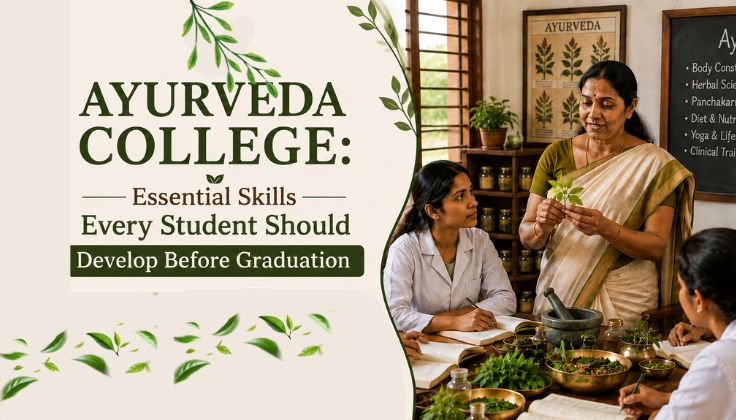
Graduating from an Ayurveda college is about more than passing examinations. A successful Ayurveda professional needs to combine classical knowledge with practical skills, clinical reasoning, communication, ethical awareness, and a willingness to keep learning. Whether you are studying at an Ayurveda College in Kerala or elsewhere, these skills can shape the practitioner you become.
The best preparation happens when students move beyond memorising information and understand how knowledge is applied in real situations.
Here are the essential skills every Ayurveda student should develop before entering professional life.
Why Do Ayurveda Students Need Skills Beyond Academic Knowledge?
Ayurveda education combines classical texts, diagnosis, medicines, therapies, preventive healthcare, and clinical exposure. Knowledge provides the foundation, but competence develops through practice.
Students should observe practitioners, interact with patients, practise under supervision, ask questions, and learn from feedback. This turns classroom learning into practical confidence.
1. Develop Strong Clinical Observation Skills
Observation is essential because patients do not always present like textbook cases. Students should listen carefully, understand patient history, observe relevant signs, and identify information needing clarification.
Clinical exposure should encourage them to ask what they are seeing and what additional information is needed. Regular practice supports better clinical judgement.
2. Connect Classical Knowledge with Clinical Practice
Ayurveda students study extensive classical literature, but remembering definitions is only one part of learning. The value comes from understanding how classical principles relate to assessment, treatment, diet, lifestyle, and prevention.
Students should discuss clinical examples with teachers and explore how Samhitas apply to actual cases. This connection makes learning more meaningful.
3. Strengthen Patient Communication
Good communication is essential in healthcare. Technical knowledge alone cannot build trust if patients feel unheard.
Students should practise listening without interrupting, asking clear questions, explaining concepts in simple language, and responding respectfully to concerns.
Try explaining a complex Ayurvedic concept to someone without a medical background. Clear explanations show genuine understanding.
4. Build Hands-On Practical Skills
Ayurveda is a practical discipline, so students need supervised experience. Clinical procedures and therapies should not be treated simply as examination requirements.
Observe demonstrations, understand the purpose of each step, practise under supervision, accept corrections, and repeat the process.
A useful cycle:
Observe → Understand → Practise → Receive feedback → Improve → Repeat
This develops competence.
5. Understand Ayurvedic Medicines Responsibly
Students should understand Ayurvedic medicines, including properties, identification, preparation principles, applications, and safety considerations.
Do not rely on memorisation alone. Understand why a formulation may be considered in a particular context, what requires professional judgement, and when guidance is needed. Responsible medicine use requires knowledge and caution.
6. Develop Research and Evidence-Appraisal Skills
Research literacy is increasingly valuable in healthcare. Students should learn how to find credible information, read research papers, understand basic methods, and distinguish evidence from unsupported claims.
When you encounter a health claim online, ask who conducted the study, what was studied, and what the findings actually demonstrate.
These questions help students become more careful readers and informed healthcare professionals.
7. Learn Professional Ethics
Healthcare involves responsibility and trust. Students should understand confidentiality, patient dignity, informed consent, professional boundaries, honest communication, and appropriate referral.
Ethical practice begins during education. Protecting patient information, communicating respectfully, documenting details carefully, and avoiding exaggerated treatment claims help establish responsible professional habits.
8. Improve Critical Thinking and Clinical Reasoning
Real patients may have multiple symptoms, incomplete histories, previous treatments, and individual lifestyle factors. Students therefore need to reason rather than simply match symptoms with memorised answers.
Ask yourself:
- What information do I have?
- What information is missing?
- What supports my interpretation?
- Could another explanation be possible?
- When should I seek guidance or refer?
This makes clinical thinking more careful.
9. Build Digital and Information Skills
Digital skills support research, academic work, presentations, communication, and continued learning. Students should use reliable online resources, digital libraries, academic databases, and presentation software.
They should also distinguish authoritative information from poorly supported online content. Digital literacy makes knowledge easier to access, evaluate, organise, and communicate.
10. Learn to Work as Part of a Team
Healthcare is rarely an individual effort. Ayurveda students may interact with teachers, practitioners, therapists, nurses, pharmacists, laboratory professionals, and fellow students.
Learn to ask questions, accept feedback, share responsibilities, and recognise when another professional's expertise is needed. Teamwork also teaches humility.
11. Develop Patient-Centred Thinking
Ayurveda places importance on understanding the individual. Students should look beyond a condition and consider lifestyle, routine, food habits, occupation, environment, and personal circumstances.
A patient-centred approach avoids a one-size-fits-all mindset. Listening to the person can improve communication.
This perspective encourages future practitioners to approach patients as individuals rather than simply focusing on symptoms.
12. Make Lifelong Learning a Habit
Graduation is not the end of an Ayurveda student's education. Professional growth continues through reading, clinical experience, research, and reflection.
Students should review what they know and identify gaps. Curiosity is a valuable professional quality because healthcare continues to evolve.
Developing this mindset during college can help students remain open to new knowledge and improve throughout their future professional and clinical practice.
What Should Students Look for in an Ayurveda College?
The learning environment can influence how these skills develop. When evaluating an Ayurveda Institute in Kerala, students should look beyond classrooms and examination results.
Consider whether the institution provides meaningful practical exposure, experienced teachers, clinical learning opportunities, useful academic resources, and opportunities to ask questions and receive feedback.
A strong educational environment should develop knowledge, practical ability, and confidence.
Student Skill Checklist Before Graduation
Before completing their education, students should aim to:
- Communicate respectfully with patients
- Gather relevant patient information
- Apply Ayurvedic principles to clinical situations
- Perform practical skills under supervision
- Understand professional ethics and confidentiality
- Find and evaluate reliable information
- Understand basic research concepts
- Work effectively with healthcare teams
- Use essential digital learning resources
- Accept feedback and improve
- Recognise when guidance or referral is needed
- Maintain a habit of lifelong learning
Key Takeaways
An Ayurveda graduate needs more than a degree and theoretical knowledge. Clinical observation, communication, practical skills, ethics, critical thinking, research literacy, teamwork, and continuous learning contribute to professional readiness.
For students considering a Ayurveda College in Kerala, the question is what they will be able to do with that knowledge after graduation.
A well-rounded Ayurveda education should help students move from learning about Ayurveda to applying their knowledge with competence, responsibility, empathy, and confidence.