
Online Panchakarma Course Curriculum: What Should You Learn Before Getting Certified?
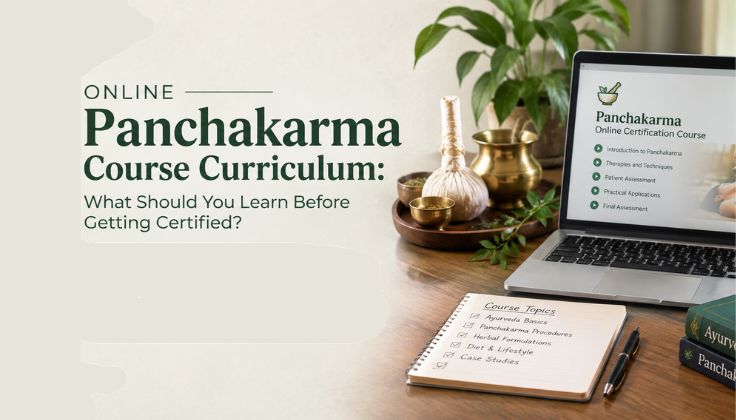
An Online Panchakarma Course can be a convenient way to build foundational knowledge of one of Ayurveda’s best-known therapeutic approaches. However, certification should mean more than completing video lessons. A well-designed curriculum should introduce Ayurvedic principles, explain Panchakarma concepts clearly, cover preparation and aftercare, and help learners understand where theoretical online education ends and supervised practical training begins.
What Is Panchakarma?
Panchakarma is a group of classical Ayurvedic therapeutic procedures traditionally used as part of a broader approach to health and wellbeing. It is not simply a detox programme or a single treatment.
A sound curriculum should first explain the principles behind Panchakarma and how it fits within Ayurveda. Students should learn essential concepts such as doshas, dhatus, malas, agni, ama, prakriti, and vikriti.
Without this foundation, learning individual therapies can become a matter of memorising procedures without understanding their context.
Which Ayurvedic Foundations Should You Learn First?
Before moving into Panchakarma procedures, students should understand the basic framework of Ayurveda. A comprehensive curriculum may introduce:
- History and fundamental principles of Ayurveda
- Tridosha theory and individual constitution
- Dhatus and malas
- Agni and digestion
- Prakriti and vikriti
- Dinacharya and seasonal routines
- Ayurvedic diet and lifestyle
- Basic concepts of diagnosis and assessment
These subjects help learners connect Panchakarma with the wider Ayurvedic system and relate each procedure to broader principles rather than studying techniques in isolation.
What Should the Panchakarma Module Cover?
A dedicated Panchakarma module should explain the traditional purpose, stages, and principles of the therapies in a clear and organised manner.
Students should learn about the three broad stages commonly described in Panchakarma: preparation, the main therapeutic procedures, and post-procedure care. The curriculum should explain concepts such as snehana and swedana as preparatory approaches, while introducing the classical procedures associated with Panchakarma.
The emphasis should be educational and responsible, especially in an online setting.
Should an Online Course Include Practical Learning?
Yes, but the practical component needs to be presented honestly.
Online learning can effectively teach theory, terminology, treatment principles, preparation methods, hygiene concepts, contraindications, documentation, and case discussions. Demonstration videos can also help students understand traditional procedures.
However, watching a procedure is not equivalent to practising it safely. Hands-on Panchakarma training requires appropriate supervision and an environment where learners can develop practical skills.
This distinction is especially important for students seeking certification. A course should clearly state which competencies can be developed online and which require in-person instruction.
Why Are Safety and Contraindications Essential?
Safety should be a core part of any Panchakarma curriculum. Students need to understand that Ayurvedic therapies may not be appropriate for everyone and that individual assessment is important.
A good programme should introduce contraindications, precautions, hygiene, client communication, informed consent, and situations requiring referral to an appropriately qualified healthcare professional. It should also discourage learners from treating serious conditions based only on information obtained through an online course.
What About Diet, Preparation and Aftercare?
Panchakarma education should not focus only on the central procedures. Preparation and recovery are important parts of the traditional framework.
Students should learn the principles behind preparatory routines, appropriate diet and lifestyle considerations, and post-procedure care. A curriculum may discuss concepts such as internal and external oleation, sweating therapies, dietary preparation, rest, and gradual dietary restoration, according to the programme’s scope.
Should Case Studies Be Part of Certification?
Case-based learning can make an online programme considerably more useful. Instead of studying theory alone, students can examine hypothetical or appropriately anonymised cases and learn how Ayurvedic principles may influence assessment and planning.
Case discussions can help learners connect theoretical concepts with realistic situations while understanding when professional supervision is necessary.
How Should Online Lessons Be Structured?
Good online learning should be easy to follow. Lessons can combine short videos, reading material, demonstrations, quizzes, assignments, and review sessions. Clear learning objectives help students understand what they should know after each module.
Access to reliable reference material is also useful. Students should be encouraged to compare concepts, ask questions, and discuss examples with instructors instead of relying on unverified social media advice.
For international learners, accessible language and explanations of Sanskrit and Ayurvedic terminology can make complex subjects less intimidating. Regular assessments can also reveal areas that need further study before certification.
What Should You Check Before Choosing a Course?
Before enrolling in an Online Panchakarma Course, look beyond the course title and certificate. Check whether the programme provides:
- A clearly stated curriculum
- Qualified and experienced teachers
- Structured lessons and learning objectives
- Panchakarma theory and Ayurvedic foundations
- Preparation and post-procedure concepts
- Safety, precautions, and contraindications
- Demonstrations or supervised practical components where applicable
- Case-based learning or assessments
- Clear certification requirements
- Transparent information about what the certificate qualifies you to do
The certification itself should also be examined carefully. Recognition by one institution does not automatically mean that the qualification permits professional practice in every country.
Is a Panchakarma Course in Kerala Better for Practical Training?
Kerala is closely associated with Ayurvedic traditions and offers opportunities to experience Ayurveda within a strong cultural and educational setting. For learners who want practical exposure, an in-person Panchakarma Course in Kerala can complement online theoretical study.
A blended pathway can be particularly useful: online modules can establish foundational knowledge, while supervised classroom or clinical training can help students develop practical understanding.
What Should Certification Mean?
A certificate should represent completion of defined learning outcomes, not simply attendance. Before enrolling, ask how students are assessed. Are there quizzes, assignments, practical evaluations, case discussions, or final examinations?
The assessment method should match the course objectives. A programme focused mainly on theory may assess knowledge through written work and examinations, while programmes offering practical components may require additional evaluation.
Key Takeaways
The best Panchakarma curriculum builds knowledge step by step. It starts with Ayurvedic fundamentals, moves into Panchakarma theory, explains preparation and aftercare, and gives proper attention to safety, assessment, and professional boundaries.
An Online Panchakarma Course can provide valuable theoretical learning and may be a practical starting point for people with busy schedules or limited access to classroom education. However, online certification should not be confused with hands-on clinical competence.
Before choosing a programme, review its curriculum, teachers, practical components, assessment methods, certification terms, and professional limitations. If practical skills are your goal, consider supplementing online education with supervised training.
For learners seeking a deeper connection with Ayurveda, structured education can be the first step toward understanding Panchakarma responsibly, thoughtfully, and within the wider principles of traditional Ayurvedic wellness.