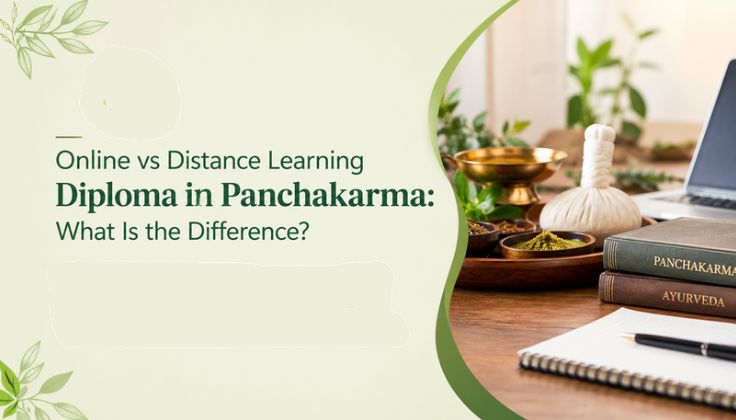
Online vs Distance Learning Diploma in Panchakarma: What Is the Difference?
Introduction to Panchakarma Education
Even though we live in a digitally dominated world, the traditional Ayurvedic system of medicine continues to garner global attention, leading to a growing demand for highly specialised qualifications. Among these professional credentials, a Diploma in Panchakarma attracts a considerable amount of attention from Ayurvedic professionals and health enthusiasts alike. For a long time, conventional classroom settings have been the norm for pursuing such courses, but today, developments in digital technologies have completely transformed educational delivery and made such academic programmes accessible to the masses on a large scale.
Contemporary prospective students are often given two distinct learning options: Online learning and Distance learning. Even though these terms are always used interchangeably without distinction, subtle structural differences are preserved across the board between them.
In this blog, School of Ayurveda & Panchakarma, a renowned and recognised Ayurveda college in Kerala, offers insights into the differences between Online vs Distance Learning Diploma in Panchakarma and how to choose the right path for you.
Before enrolling on a Diploma in Panchakarma, it is important to acknowledge and understand such differences.
Defining Online Learning in Panchakarma
The foundation of online learning rests on good internet connectivity and robust digital learning platforms capable of delivering educational content seamlessly. Lectures, Video instructions for treatments and therapies, collaborative seminars and engaging masterclasses are usually streamed on web-based online portals or specialised applications. Core academic modules concerning Ayurvedic anatomy, dosha analysis, and the basic foundational principles of purification are attended remotely by the learners. Digital spaces and live video sessions are often employed to streamline communication and foster dialogue between teachers and students. As a result, flexibility is offered, but even then, uninterrupted internet access and digital literacy are non-negotiable for successful participation.
Defining Distance Learning in Panchakarma
Distance learning is defined by a more conventional correspondence model, although modern distance learning platforms frequently integrate mailed study materials or assigned online learning packets. In the past, physical learning materials such as textbooks, printed content and biannual postal assignments were sent to the student’s residence. Within the framework of distance learning, independent study is heavily emphasised, which requires learners to maintain significant discipline and razor-sharp time management.
Interaction with mentors is mostly asynchronous, occurring via written feedback on submitted assignments or pre-scheduled telephonic consultations. Even though self-directed academic progress is held in high regard, a traditional format of distance learning cannot incorporate practical demonstrations seamlessly.
Core Differences in Structure and Delivery
The key structural differences between these learning methods lie in how they transfer knowledge. Online learning environments provide learners with dynamic and versatile audio-visual-rich experiences via digital modules, live classes, and responsive virtual assessment channels. On the other hand, distance learning methods are inclined towards physical media such as printed texts, structured course textbooks, and correspondence review that can potentially be delayed. Moreover, online learning requires advanced technological infrastructure, but distance learning programs can be completed with very little online interaction.
The Critical Challenge: Practical Training Limitations
Although online and distance learning have advantages, they also have shortcomings when it comes to practical training. Panchakarma is predominantly a hands-on medical science that involves complex patient care methods such as oil massages, therapeutic sweating and elimination techniques. Purely online or distance learning structures are fundamentally restricted to theoretical instruction and observation via video; indispensable tactile techniques, pressure calibration and management and face-to-face client interaction cannot be mastered through a computer screen or a printed hardcopy textbook. Therefore, it is necessary to bridge this gap by implementing extra residential training camps and clinical internships for the learners by well-known institutions.
Conclusion:
At the end of the day, the decision between an online or distance learning diploma in Panchakarma depends on the individual’s personal and professional goals, access to digital technology, and learning choices. While online learning offers a more interactive and visually rich theoretical foundation, distance education relies on conventional pathways that prioritise independent study via printed materials. Irrespective of the chosen pathway, it is important to understand that theoretical knowledge must be accompanied by hands-on clinical experience to fortify professional competence in Ayurvedic treatments. Prospective learners must always verify whether direct experiential sessions are included in the curriculum before enrollment is finalised.