
Ayurveda Certification Courses in Kerala: Skills Every Professional Therapist Should Master
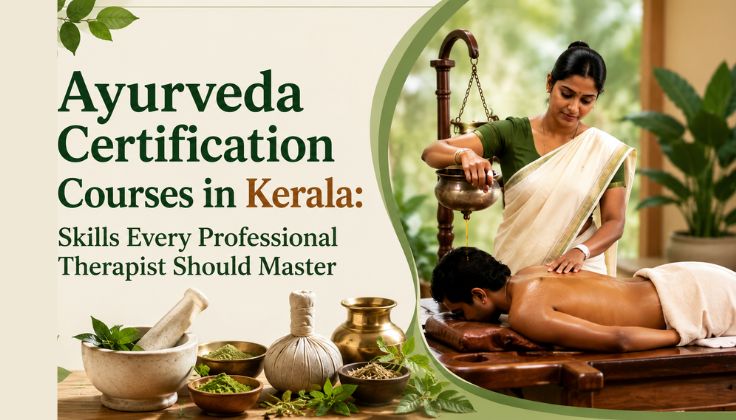
The rising demand and preference for holistic healing has elevated Ayurveda to the apex of the global wellness industry. Known to the world as the birthplace of ancient Ayurveda, Kerala has now become one of the most sought after destinations for individuals looking to gain a professional certification in this ancient science. However, acquiring a credential is merely the first step, to make a mark in a hyper competitive landscape, therapists and practitioners must master a specific set of distinguished capabilities and advanced competencies. Through end-to-end training programs and workshops in Kerala, several core skills are harnessed to ensure therapeutic excellence and long term career progression.
In this blog, School of Ayurveda and Panchakarma, an ayurvedic training institute gives an insight into the domain of certification courses in Ayurveda in Kerala and the core skills every professional therapist needs to master to stay on top of their game.
Mastery of Tridosha and Prakruti Assessment
The essential grounding of Ayurvedic Biology is considered non-negotiable for any professional practitioner. Based on the principles of Ayurveda, the human body is perceived through the perspective of three core energies, which are also known as Doshas. Vata, Pitta, and Kapha. Certification courses in Ayurveda deeply prioritize identifying and mapping the unique constitution of an individual (Prakruti) and detecting the presence of any imbalances (Vikruti).
By joining Ayurveda certification courses in Kerala, therapists harness the skill to observe certain subtle physiological signs and changes, such as the texture of the skin, diet habits, digestion patterns and emotional landscapes. When professional practitioners do not attain the capability to analyze these energy patterns and balances, customized treatment protocols cannot be administered effectively. In Kerala’s premier ayurvedic training institutes, this diagnostic foundation is not treated as a theory, it is imparted as a non-negotiable practical skill that sharpens the practitioner’s observational powers and helps them to use those insights to decide the next plan of action during clinical treatment.
Precision in Classical Panchakarma Procedures
The foundational pillar of Ayurvedic purification is known as Panchakarma. It is a comprehensive five fold detoxification process that requires a high level of preparation and rigorous technical mastery. Professional ayurvedic certification programs in Kerala make sure that these therapies are executed with meticulous precision and care. Therapists are thoroughly schooled in the initial preparatory phases such as Poorva Karma which comprises the internal and external oleation (Snehana) and sweat driven purification (Swedana).
Each process, whether it is Vamana (emesis) or Vasti (enema therapy) must not be executed without a deep and seasoned awareness of pacing, tactile force and patient endurance. If not administered properly, these high intense cleansing procedures can have adverse effects on the individual. Kerala’s clinical environment offers meticulous hand on training that is required to promote patient safety and achieve treatment success.
Specialization in Traditional Kerala Therapies
While the Panchakarma therapy is practiced all over India, Kerala is globally recognized for its highly specialized regional treatment methodologies. A Diploma in Panchakarma is offered by all reputable ayurvedic colleges. As per the principles of Ayurveda, a practitioner with reputable credentials is supposed to demonstrate Keraleeya Vishesha Chikitsa. It consisted of profoundly sophisticated treatments such as Pizhichil, where warm medicated oils are continuously poured throughout the body and Navarakizhi, where a massage is administered by employing medicated rice poultices.
The coordination of movements, maintaining exact oil temperatures and the precise application of pressure while executing these ayurvedic treatments require a great amount of physical stamina and synchronization. Gaining a stronghold in these techniques is what differentiates ayurvedic professionals from Kerala when compared to global wellness practitioners, making them the most sought after by luxury hotels, resorts and hospitals alike.
Identification and Preparation of Medicated Formulations
The duties of an ayurvedic practitioner are confined to being a bodyworker. They must possess a profound understanding and familiarity of herbal pharmacology (Dravyaguna) and pharmaceutical preparation (Oushadha Guna). Ayurvedic colleges and institutions offer unprecedented access and exposure to medicinal plants, their properties and the time tested traditional methods utilized to process them for the purpose of healing.
Therapists must know and understand the properties of all kinds of medicated oils (Thailams), herbal powders (Choornams) and decoctions (kashayams). They must also be capable of choosing the right formulation depending upon the patient’s constituency and conditions, and also learn to prepare kizhis (poultices) at that moment, on site. This is a core competency that is imparted in all certification programs, ensuring that the usage of medicinal plants are perfectly in sync with the physical treatments and therapies.
Accuracy in Marma Therapy and Anatomy
To master safe practice as an ayurvedic professional, the knowledge of the subtle channels of energy and physical anatomy is paramount. Special attention must be given to the Marma Points of the human body, which are home to 107 intersections that act as the meeting points of mind and matter.
During the process of a massage or targeted therapeutic intervention, precise stimulation of these points can accelerate healing and improper stimulation can lead to severe discomfort or injury. Ayurvedic certifications programmes in Kerala bridge the gap between ancient texts and contemporary structural anatomy. By incorporating such connected learning practices, therapists will be able to harness the precision and clarity required to handle these energy points with care, and thus streamlining and promoting relief from disorders and physical stress
Clinical Professionalism and Soft Skills
Apart from being at the top of clinical expertise, the expectations and requirements of the contemporary wellness industry has drastically shifted, with high standards of hospitality and clinical management becoming mandatory and not just an afterthought. Premium tier ayurvedic institutions in Kerala have now made soft skills training, maintaining hygienic standards and professional ethics compulsory in their curricula.
Practitioners are trained to maintain flawless personal hygiene, a placid and rehabilitative atmosphere and engage empathetically with every client. Moreover, it is important to have foundational knowledge in patient documentation, inventory control of herbal medicines and other botanical agents, they must also prioritize mastering cross-cultural communication as well. Hence, these holistic training programmes ensure that the graduates are empowered with the highest level of knowledge and are well equipped to effortlessly integrate themselves into globally renowned holistic healing institutions, luxury resorts and spas.